
Life is meant to be lived before it is too late. Treasure those poetic moments, you will never experience them twice. ( Poem recited on YouTube) https://www.youtube.com/watch?v=HfzslNFaEn0&t=17s Please like, share and subscribe to the channel.

Life is meant to be lived before it is too late. Treasure those poetic moments, you will never experience them twice. ( Poem recited on YouTube) https://www.youtube.com/watch?v=HfzslNFaEn0&t=17s Please like, share and subscribe to the channel.
https://www.amazon.com/dp/B0CVRNRZVL Soulful Rhapsody: Step into a world where each note is a heartfelt expression, and every melody weaves a tale of love and longing. "Soulful Rhapsody" is not just a collection of poems; it is a symphony of emotions, an ode to the enduring power of love. Read one of the poems below: I hope you enjoy it. Innamorare The Italian prudent in a small town in Italy Tells us his story A tale about his lost love So callously Slipped through His fingers. He's caught in a tirade Of wishful thoughts Innamorare he declares Is both a curse and a bane A malevolent affection One he foresees As a misfortune. Would he perhaps be right? Not even the picturesque setting Before where he rests His weary feet From his long fatigued travails In search of his Wandering thoughts Gone astray just as his lost mind Has reduced him to madness For a woman's sweet love. Ah, he sees her now among the clouds A tiny pearl at first And then a wondrous sight Of a beautiful outline Of a sensuous woman. Then she was gone. His heart clutched at his bosom Would he find among the throes That walk upon this mighty Earth One as beautiful as her? He had seen her once before Only Once And it was enough To set his heart on fire For a lifetime. -end- Get a copy as a tribute to Valentine's Day A book for lovers to gift, or a keepsake to relive the magic of love. And, if you do, please leave a review. I'd love to hear from you.

A good friend of mine has a very warped and funny sense of humor. One of his favorite comments is: “Opinions are like a@@holes. Everyone has one.” Every time he says this, while I do agree with him, I also laugh with him. Keeping that in mind, here is one of my opinions. While many will agree with me, I also realize there will be just many who won't. As my friend says, you're entitled to yours. I don't often read magazines; I just don't take the time. I do, however, read books to relax, write stories, and dabble around with photography. Truthfully, I only read two magazines. One of them I do enjoy is The Week; I like this magazine because it contains a bit of news from every state, there is a science section, important national news and so much more. It is just about the most interesting magazines on the market. I probably should have written this article years ago, but at the time, I was angry and put the magazine away, as I kept thinking, “How dare he?” Then through the years, I'd forgotten about it. Now, looking back to that issue of March 27, 2015, one of their columns was about clothes designing company called Dolce & Gabbana. It was that article that angered me beyond words. One of the owners, Domenico Dolce was quoted during an interview as saying, “We oppose gay adoptions. The only family is the traditional one.” He went on to describe children born through IVF as “children of chemistry, synthetic children. Rented uterus, semen chosen from a catalogue.” Apparently, Mr. Dolce does not believe in adoption or in in-vitro fertilization. Actually, according to his statement, he doesn't even believe in gay marriages. It's a shame when you think about it. There are so many wonderful, intelligent, gay people who have made their mark on the world and became pillars of society. I have met and made friends with many people who are gay but rather than go into all of them, I prefer to tell you the response to Mr. Dolce's comment made by Elton John. Elton John has two children with his husband, David Furnish. Each child had a surrogate mother who conceived them by in-vitro fertilization. Mr. John's response was: “How dare you refer to my beautiful children as pathetic. Your archaic thinking an out of step with the times, just like your fashions. I shall never wear Dolce & Gabbana ever again.” Ironically these Italian designers who happened to make this atrocious comment are gay, but they consider themselves traditional believing that while they should and can live together, they should not marry nor have children. That's something I just don't understand. If you have a partner with whom you are in love, why shouldn't you get married? Why shouldn't you have children, whether it's by in-vitro or adoption. And let's for a moment jump off the Rainbow train. Whether gay or not, what happens to couples (men and women) who desperately want a child to increase their family but for whatever reason, can't conceive? You mean to say they shouldn't be allowed alternative methods of having children? Since that article, Mr. Dolce has apologized to the gay community. Yet, I can't help but wonder why? Did he apologize out of sincerity? Or did he apologize because his sales were in decline? Hmm. Makes you wonder. Sorry, even if I could afford the items Dolce & Gabbana sell, I surely would never purchase any of them. I'll stick to Walmart and Target!
The nightingale watched him like a hawk. The flautist took out his flute, and looking up at the nightingale, he said, “I shall play a tune to match the moonshine for you. You can sing along if you want.” The soothing sounds of the flute reached the far corners of the land. The nightingale became a shadow for it couldn't match the melodious composition of the song on the flute, a love song that awoke the night from its slumber. Please watch the short video of The Nightingale & The Flautist, taken from The Goddess of the Himavan, best-selling ancient & classical literature on Amazon. https://www.youtube.com/watch?v=arpFUl7fJRU&t=57s Thank you for watching. Please subscribe, like, and share the video. Happy New Year, 2023 everyone.

“You got this. It's just a walk,” I told myself as I stared at the mirror in my room. It had been so long since I left my house that I forgot how to dress nicely. I had finally chosen my outfit for the day after trying out my whole closet. I closed my eyes and tried to find any positivity but nothing. My shaking legs began walking out of the room while I checked if I forgot anything. “My mask!” I exclaimed. Silly me! We've been in a pandemic for six months but this was my first time wearing a mask. “This is uncomfortable. How can I breathe?” I asked. I readjust my mask to make it more comfortable. Attempt failed. “Let's try this again,” I mumbled. “You got this. It's just a walk,” I told myself as I stared at the mirror in my room. I checked my fit and decided not to change it again since I'd have to look through the piles of clothes. My shaking left leg lifted off the ground and slowly stepped forward. Then it was my right leg's turn. It was surprisingly easier than my left's. I continued my journey and was delighted to find that it was getting easier with every step. “I actually got this,” I chuckled. I said it too early. Well, it was easy until I had to face the most daunting task: opening the front door. My trembling right hand reached inside my left pocket and slowly grabbed the key. I proceeded to insert the key into the keyhole but quickly pulled it back. “Come on, you can do this,” I tried to encourage myself. My right hand approached the keyhole again. But it quickly backed away. Then back towards the keyhole. After a few minutes and a million tries to get my right hand to unlock the door, I picked another option: my left hand. “You got this,” I motivated it before handing it the keys. Click! I did it! I opened the door; it felt magical. I took a deep breath and walked forward. The fresh air calmed my heart and blew away all my worries. It tempted me to take another step. Before I knew it, I was next to my mailbox. I looked around and I could feel a smile forming. I turned to my left and saw my neighbor playing with her grandkids in her yard. She told me she hadn't seen them in so long. She was so happy to finally meet them again. I can't help but smile a bit more. I then turned to my right and saw my other neighbor sitting on his rocking chair. Beside him was an empty rocking chair. The chair belonged to his late wife who passed due to the virus. However, he still made her tea every day. My smile slowly disappeared. I decided to walk to the nearby park. I saw that the park wasn't as crowded as it was. There would usually be kids running around the playground, while their parents were chatting on the nearby benches while also watching their kids. Grr! My stomach growled. I just realized that I was so busy deciding on my outfit that I missed breakfast. I decided to go to the hotdog stand. “Can I get a hotdog?” I ordered as I grabbed my wallet from my pocket. “Only that?” asked the owner. I saw that the owner needed money so I ordered a soda. “Ok, that will be four dollars,” the owner replied. “Here's ten dollars. Keep the change. Hard times?” I felt sorry for the owner. His eyes lit up as I handed him the money. “Ya, it used to be so crowded but now not so. Thanks for the tip,” explained the owner. “I'm sorry to hear that. Have a nice day,” I waved goodbye and sat on a bench. The hotdog was really good and the can of soda was very refreshing. Once I finished my small meal, I decided to jog home using the longer route. I jogged through a neighborhood filled with beautiful houses. However, it wasn't the houses that caught my attention; it was the people. On my right, there was a family playing together in their front yard. I guessed the parents were working from home. To my left, there was a truck filled with boxed meals. There were a few people handing out those meals to the community. They even offered me a meal but I politely refused because I knew someone else needed it more than I did. It suddenly started raining. I didn't know what to do. I was pretty far away from home. Luckily, the people who were handing out meals offered me a ride home. I would usually refuse to get in a vehicle with strangers but these people had good intentions and I didn't want to catch a cold. Several minutes later, I was home and thanked the kind people. I cleaned up and said, “What a new world.”
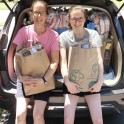
“Put yourself first.” It's a mantra that most of us live by and practice daily, and in the midst of a crisis, our own survival and wellbeing become especially imperative. But just because we put ourselves first doesn't mean that we should forget about others. The world functions the best when people help out one another and make an effort to show that they care. This seemingly simple concept is challenging for many, myself included. In the early days of the pandemic, the only thought on my mind was how much of an inconvenience it was on my life. I didn't realize then how fortunate I was because I was too focused on myself to stop and wonder for a single second how others were managing. This wallowing in self-pity lasted for a couple of weeks until my stay-at-home mom suggested that I help her deliver food. My mom has been an active participant in the food assistance programs at our church over the past few years. She'd gotten especially involved in the Fern Street Backpack Program, which delivers backpacks full of food to food-insecure families with children enrolled in the school district. When remote learning went into effect, my mom switched to home deliveries. But delivering forty-plus bags of food all over our town was no easy feat, and my mom needed help. Seeing as I'd been laid off from my three part-time jobs and was holed-up at home, I was the perfect assistant. Prior to this, I had little involvement with food assistance. Sure, I knew what it was, but I'd never experienced it myself or been close to anyone who had. The neighborhood where I live is upper-middle-class, predominately white, educated, and privileged. This was the environment I'd grown up in. It was all I really knew. I'll always remember the first few days of our deliveries and how shocked I was at how drastically different living conditions were just on the other side of my town. Every Wednesday and Friday, my mom and I would drive to each location, lug heavy paper bags—two per family—overflowing with food out of our car, and leave them on doorsteps or outside of housing complexes. We'd wait for someone—usually a mother, some of whom weren't much older than me— to collect the bags, then drive off to our next destination. On one day in particular, it was incredibly hot—blistering, even. My latex gloves were damp with sweat and my bare legs stuck to my car seat as my mom pulled into an apartment complex where four families resided. She eased over a speedbump, being extra cautious since we had eggs in the back, and parked under the shade of a tree. The mother of the first family, who I'll call Nadine, lived in the basement of one of the apartments. She was disabled and had a hard time walking, so we routinely delivered her food through her window. As my mom unloaded two bags from the car, I called Nadine on her phone to let her know that we'd arrived. “Wonderful!” she exclaimed enthusiastically! “I'll be right there.” A few moments later, she opened the window with a broad smile on her face. I could tell that she was warm by the sweat that had formed on her hairline. While most of the families kept to themselves, Nadine loved sharing the details of her personal life with us. She had cancer and underwent chemo semi-regularly. She was a recovering alcoholic and a devout Christian, always ending her conversations with us with a “God bless you.” She had a daughter not that much younger than me. She had a tough life, and yet, she was one of the most positive people I've ever met. On that particular blisteringly-hot day, we had a couple of cartons of ice cream from a Trader Joe's pickup we'd made earlier in the week. We gave Nadine one—butter pecan, I believe it was—and her eyes lit up with excitement. We received two “God bless yous” that day—one for the ice cream; the second as we were heading back to the car to finish our deliveries. When we drove past her window, which was still ajar, Nadine's smile was unwavering. I couldn't remember the last time something I'd done had had that effect on someone, but it was an amazing feeling knowing that I'd made a difference. It's been over a month since we made our final delivery. My mom plans to start back up in the fall, and I'll probably join her. Assisting these families has done more than just connect me with my community; it's humbled me and reminded me of my privileges. No one is enjoying this situation. That said, I'm lucky to have employed parents, access to basic resources like food, and be in decent physical health. It seems only right that someone like me should make an extra effort to support those who aren't so well-off. After all, just because we can't be near each other doesn't mean we can't still look out for each other.

On March 9th, 2020, my husband and I decided to start self-isolating. We were on a flight from Los Angeles back to Seattle the day prior. The man in the window seat was coughing as he talked to my husband about the cruise he was on. The news recently told the story of a security worker at the L.A. airport who was diagnosed with the virus. Between the coughing cruise man and the news, we thought we should stay home for a few weeks to make sure we were healthy. My fortieth birthday fell in this time frame. Not having any sort of get together with friends was the last thing I expected to happen on my milestone day. While weeding the yard in front of the house in those first weeks, a young blond woman walked towards me slowly and started talking to me from the middle of the street to keep her distance. “Hey! Do you live here?” she said. “Yes. Where do you live?” “I just moved into that unit across the street." She pointed. "I'm single and I don't know anyone here, so I wanted to say hello.” “Welcome to the neighborhood! What's your name?” “Mari with an ‘I'. What's yours?” We exchanged small talk that morphed into big talk. I found out we had both moved from the same neighborhood in Brooklyn, about ten years apart. I also discovered she was semi-disabled by multiple auto-immune diseases and Lyme disease. She asked if it was alright to have my phone number in case of any emergencies, so I gave it to her. I turned to finish weeding, the flowery part of the yard looking better than it ever had before. Mari did not reach out again for a while. She texted me one day to ask if I had something to sleep on. Her air mattress had popped in the middle of the night. I offered her our camping roll, which was a few inches thick. She thanked me profusely and I left it on her porch in the evening. I was not sure how sleeping on it for an extended period would feel, especially with body aches. Hopefully, it would be better than a bare wood floor. The following day, another neighbor surprised me and mowed the city strip in front of our house. (It is a three-foot-wide strip of grass between the sidewalk and the street curb.) We only had a weed wacker, so it was a lot of effort to cut all the grass. I watched from the window as this amazing human walked across and back in about two minutes, saving us at least a half hour. She lived two houses away and I had never met her before. Seeing that she had lots of plants in her windows, I brought her a houseplant she did not have and a thank you note. She now mows the little plot of grass regularly and I leave her little gifts. Neighbors began helping each other more, many of us with newfound free time. I saw a man bringing a jug of either hand sanitizer or booze to a house bound couple nearby. The folks diagonally across the street put up a simple sign that reads “Thank you delivery heroes” with a box of treats next to it. I gave some fabric face masks I sewed to a different neighbor who mentioned she needed some. She later brought me homemade muffins and told me to help myself to her herb garden. I continued to help Mari when she was in need. She never asked for anything major, only to borrow home goods on occasion or to ask me to bring a package to the post office. After a few months, she moved into a special care facility. My house always felt like home, but my neighborhood never felt like a community the way it does now. All of us used to constantly rush from place to place, live our own unique lives, and wave hello in passing. My neighbors and I now spend socially distant time outside together, getting to know each other better. In disconnecting from ‘normal' life, I feel more connected today than before. Today, I am grateful for my neighbors.

My dear children, let me tell you a story. A warrior princess who not just believed in empowerment but proved her metal by conquering her fears than just owning a castle of her own. An elegant soul with a pure heart mesmerized with the beauty of patriotism and valor, who adored her country so much that she decided to give it all. Myself being a coward tried to stop her but she had formulated her decision so firm, I just couldn't stop her. But…the day she wore her uniform for the first time, that very moment, a part of me felt proud of having her in my life. That marked the beginning of her journey striding through all odds. Soon, I realized that she was the one inspiring me and changing my perspective towards life. I took pride in the person I was becoming, all thanks to her! One after the other, badges were added to her uniform just like the feathers in her hat. One fine day, I decided to surprise her by joining the army. I wanted to show her, how blessed I am to have a companion like her in my life. The day I got the letter of my selection, I couldn't contain my excitement. The very next day she was going to visit me. All good things come to an end, my happiness was shattered when I received her, not in person but in a frozen box. My poor heart knew nothing about the pain experienced when you lose your loved ones. I cried all day. I was finally able to conclude that I am going to walk in her footsteps and make her proud someday. My dear children, I stand in front of you as a dauntless warrior who once used to get panic-stricken with every little thing. I have nothing more to say but one thing, your mother was my role model and her love kept me going. Even at night when I look at the stars, I feel her presence so warm, I sleep tight knowing that everything is alright. Go to sleep now. It's getting late!

Thus every writer's motto reads: mad I cannot be, sane I do not deign to be, neurotic I am. Roland Barthes
Have you ever wondered what it's like to have four or five, or maybe more, songs stuck in your head? Imagine having that many people crammed into a small room and all desperately vying for your attention. Now imagine that, in a classroom, when you really want to sing so they leave you alone. But you can't, because a) you'd look like a total weirdo and b) there are other people trying to focus. That's an average day for me. Music is a big part of my family's culture, and it has a lot of meaning for me even beyond that. I think about this a lot: what if we could use music as a tool to connect with people? What if we could use it to tell stories and bring communities together? Growing up, my dad was a music enthusiast. We're a big family - eight kids, all from the same parents - so we made a lot of dishes at dinner. We live in an old farmhouse with no dishwasher, so at the end of the day, we'd all clean the kitchen and do the dishes together. This was in the days before Spotify and iTunes, back in the mid-2000s to early-2010s so if we wanted music, we had to sing. And sing we did. My dad would lead the melody and my sisters would sing harmony and to my eight-year-old ears, there was nothing more beautiful. The world was at its brightest when we were singing together. It made - actually, still makes - you feel like you're part of something greater than the sum of its parts. Even before I was born, my family was musical. So much so that I began to recognize certain songs in the womb, and to put me to bed when I was little, you had to sing "One Hand On The Radio" by Aengus Finnan or I wouldn't sleep. I'm seventeen now. I'm going to be a part of the senior music class, studying in-depth music theory and refining our skills on our chosen instruments - the flute, for me. This class has reinforced what my childhood led me to believe: when you're involved in music, you become part of a greater whole, on two levels. The first level is the local community. I've met some amazing people through music, people that otherwise I'd have no way of knowing. It draws strangers together, with all different strengths and weaknesses, and helps them overcome their failings to create art. Painters use pigments to decorate space, but musicians use sound to decorate time. Being part of that is a spectacular feeling, but one that's quite impossible to describe to someone who hasn't felt it before. The second level is the global community. Just about everyone I know has at least a superficial appreciation for music in some form. If you showed someone from the other side of the world a classical piece like Vivaldi's Four Seasons or Tchaikovsky's Swan Lake, they'd have a hard time denying that it's beautiful music. Even if you think it's boring, you can certainly appreciate the skill required to play the pieces. This is true for many other forms of music too, not just classical. Music is a community thing and it's meant to be shared. I could go to Europe or the Middle East or Africa and find another musician to play with, regardless of lingual, cultural, or social differences and perform a piece with them. As long as we can both read music, we can let go of the barriers of society. As a musician, I'm not constrained like others are. My art form allows me a certain kind of freedom and a crazy connection to others that can't be taken away from me. You can't unlearn something, after all. So whether you just listen to music when it plays on the radio or you're a fanatic like me who listens to everything under the sun, remember that music is much more than nicely organized sound. Imagine a scene from your favourite movie, a very emotional one. Now remove the background music, and you're left with something a little more shallow. Music is the language that communicates beyond words and extends beyond the barriers of language. It is the one thing that can speak to anyone no matter where you are or what your culture is. It's the universal language and using it, we can connect with all kinds of people. And in a world that's so divided, so disjointed, couldn't we use a little more unity?
It was still the beginning of the academic year and my friends wanted us to study together. One of us offered to host us at his place, as he had a black board that we could use to do mathematics. I wasn't a good student, I hadn't been one for a very long time, but I tried to pass, so I welcomed the idea and decided to be apart of it. It didn't last for very long. I don't think I have ever known why we only had a few sessions. But we really worked, I mean, they really worked as most of the time I didn't do much. For some reason, my interest in school had grown weak over the year. I often felt like I was in a cage where I wasn't allowed to express myself and do my best. I was actually repeating the class, the four of us, Thiam, Yannick, Gabin, who was hosting us, and me where all in the same class the previous year. One day, we were working on some maths exercises. A student from a literary class of our high school came to us and asked to help him solve a few exercises. We hadn't covered the chapter yet, but we had instructions in the book, so we proceeded to help him. I was sitting and watching my friends doing the work most of the time. But then came a problem that we didn't know how to solve. That caught my attention. No one had a clue of what method or formula we could use to solve it. But looking at it, I thought I might be able to figure out the answer. I could remember that I attempted the previous year to do the same unsuccessfully. But I thought that maybe this time I could. I was hungry so I went out to the shop nearby, bought some biscuits and went back. I sat back and looking at the problem on the board, I thought deeply. As I got close to finding the answer, I stood up and went towards the board. I found it and wrote it on the board. What I did after was pretty unexpected. I told my friend, “This is the answer that was asked. Now how do we get here from the given data?”. Gabin protested, “Is that really the kind of answer that was asked?!” Thiam initially thought it was but they had to argue for a little while until they agreed. I let them talk among themselves, and when they were done, I asked again how we could get there. Thiam asked me, “But how did you come up with that answer?” and I just replied, “I thought about it.” I knew I could do things most people could not, but even though back then they called me Genius, they didn't really know what I had in my toolbox. We had to wait for a while before Thiam finally found in the book the method we needed to use to solve the problem. He applied it and to their great surprise, he found the same answer as what I had written on the board. I didn't get praised of it, they were shocked! Thiam asked, “How did you manage to get that answer?!” I told him again that I had thought about it and added that I could do this kind of things. He started suggesting that I should be a very “spiritual” person, that I had done something mystical when I went out to get the biscuits. I didn't like it. I never liked to hear my classmates attributing what they didn't understand to spiritual phenomenon. In the past I would object whenever some of them would say that the scientists who discovered the laws of science and established formulae were involved in spiritual activities. At times I would tell them that I could do the same and didn't need to leave my body. But they wouldn't believe me. How could they? I was an average student, and to many them, it meant that I was better than them. That day my classmates actually witnessed my ability, but they were still not willing to just let me tell them how I did that exploit. The day after, we were walking home, and someone brought up what had happened the previous day. Thiam, who is a critical thinker, expressed his intrigue saying, “I went home asking myself -How did this guy do it? -, and I was struggling to sleep.” I started telling them that what I had done was not, extraordinary but he objected that it was mind blowing. He asked Gabin to confirm, which he did. I told them that it was normal, that some people had abilities that allowed them to understand science at a deeper level, but they weren't many. I had believed for a long time that they were others like me, and I faced so many challenges because we were scarce and as a result, people were not used to dealing with the way we function and witnessing what we could do. That day I felt so different and alone! I knew my friends and what they could do as human beings. But there was a part of me that they didn't know at all, one that caused them to look at me as if I was an alien who just landed from a spaceship, when they witnessed it. I thought that if more people knew about our existence, such things wouldn't happen to us. That day, like many other days, I felt like letting everyone know. I felt like shouting to the world “We exist!”.
New Blog post You can use many things that happen to you or you observe to spruce up your novel. http://www.universalchaospaladin.com/using-life-events-as-parts-of-stories/




_media.png)