
FIRE

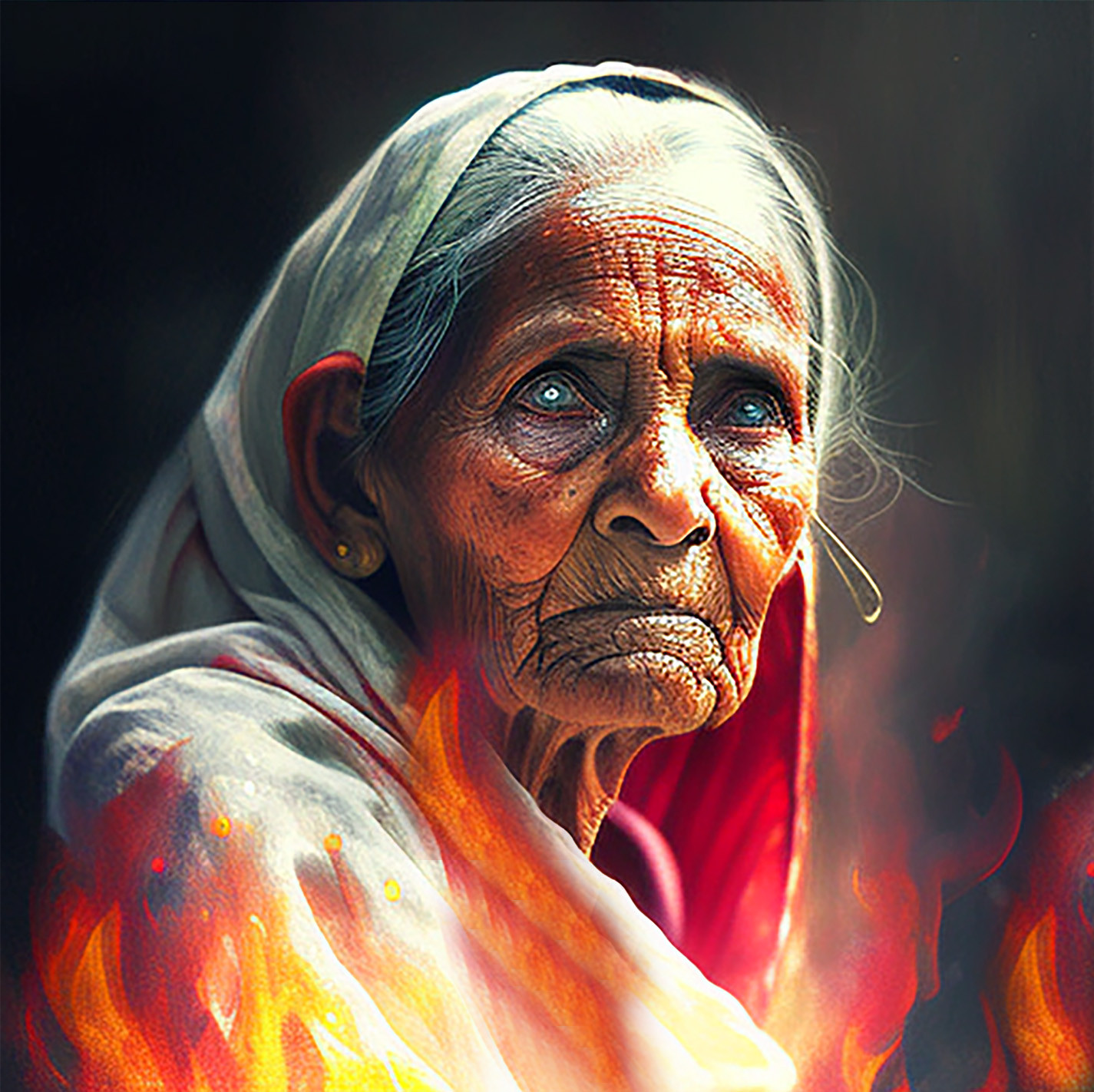
Last night I dreamed about my foster mother. She was wearing a white sari with a blue border, and she looked sad. She passed away in 2008. It has been almost 15 years; I have not forgotten her for a moment. I lost my biological mother when I was only nine months old. My mother's stepmother, Mariyam, took me in her care and became my foster mother. Ten children were born in my foster mother's womb, but unfortunately not a single child survived. After my mother passed away, my maternal grandfather took me from my father, and then gave her the responsibility of raising me. When I was a child, I used to call her ‘mom,' later, due to everyone's continuous reminder, I began to call her "Didi". I did not see my maternal grandmother. Because she died before I was born. So, Didi was my mother and grandmother both at the same time. Didi was medium tall and an incredibly beautiful woman with a pair of deep-black eyes, and thick eyebrows. She had wavy-long hair, a pointed nose, thin lips, fair skin, and a betel leaf shaped small face. She always wore light colored cotton saris. She was used to chewing paan (betel leaves) with lime, betel nut, and tobacco leaves. Her lips were always red because of betel leaves juice. A sweet smell came out from her mouth when she spoke. She was kind and generous, and always tried to make others smile, even when she was sad. I get upset all day when I see Didi in my dreams. Didi's life story was full of sorrows. Her parents died when she was young, but she had a sister. Her sister got married at an incredibly early age, just like other Bangladeshi girls were married in 1940. Two years later, Didi's sister was killed by her husband for his second marriage. Didi's father had a huge land, but her cousins possessed all of those. As a result, Didi was mentally depressed all the time. Didi has brought me up with utmost love and care. Her love was unconditional. When I was young, I was often sick, and Didi had to face a lot of suffering for me. When I was nine years old, my father took me to him for my bright feature. At that time Didi always cried for me and became almost mad. After my marriage, most of the time Didi stayed with us and took care of my children. She raised my children in the same way she raised me. Didi always looked stunned and upset because of losing her parents, sisters, so many children, and finally her husband. There were also various age-related diseases. As a result, Didi became very weak and could not remember anything. She could not walk properly. Her arms and legs were shaking always. After the age 60th, she became anxious for death. She wanted to die in her husband's house. She did not want to stay with us anymore and moved to her husband's village home. There she lived with her husband's youngest son Altaf, whom she raised. She lived almost 70 years. But her death was very tragic. One night there was load shedding at home. A cup lamp was flaming on the floor. Didi got down from the bed to go to the bathroom. It was winter. A shawl was wrapped around her body. Maybe a part of the shawl was hanging inadvertently, and suddenly the hanging shawl attached to the fire. She did not understand anything at first. At one point, the fire started blazing. Didi's whole body was burnt in the fire, and she died on the way to the hospital. The next morning, my aunt gave me the news of Didi's death over the phone. My uncle's house is about 15/16 hours' drive from Dhaka. It was not possible to keep Didi's half-decomposed body in the village environment for so long, moreover, I did not want to see her burnt face. I wanted to keep Didi's acquainted face in my mind. So, I did not go. But I went with my family to make her exequy's program after forty days. Before that, when I went to my uncle's house, Didi was always busy taking care of me. Although recently she could not do it herself, she gave instructions to my aunties. The house, without Didi, reminded me more of her. My heart was crying for her. In my life, there are lots of memories of Didi and I will never forget those! Didi passed away in 2008. It has been almost 13 years; I have not forgotten her for a moment. She is present throughout my being. When I think about the sufferings of her whole life, my eyes fill with tears. God seems very one-eyed then. He floats someone in the sea of happiness, and floats someone in the tears from birth to death. Why did not make Didi's life a little happier! I believe Didi is living in a better place than before. God, please... please keep my Didi always happier in heaven.


_media.jpeg)